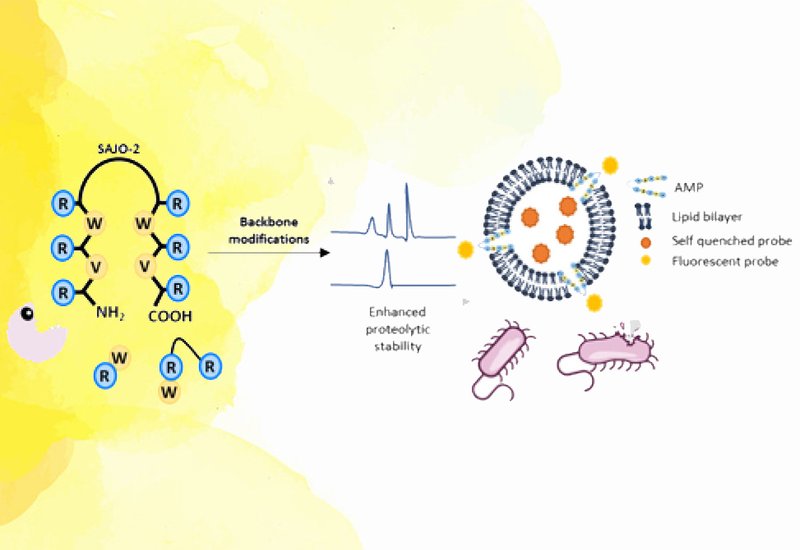
Antimicrobial resistance, AMR, kills more than four million people annually and continues to narrow the arsenal of effective treatments. Antimicrobial peptides, AMPs, have long attracted interest as leads for next-generation antibiotics because they act on the bacterial membrane rather than on a single enzymatic target, making resistance harder to acquire. Yet a recurring obstacle limits their clinical translation: proteolytic instability. The β-hairpin peptide SAJO-2, built around a D-Phe-2-Abz turn motif developed by Sarojini and colleagues, displays broad-spectrum antibacterial and antifungal activity but is rapidly cleaved by β-trypsin. Earlier fluorination work from the same groups improved potency yet worsened enzymatic susceptibility, leaving a clear design challenge unresolved.
Researchers in the Koksch Group at Freie Universität Berlin and the Fulde Group at Freie Universität Berlin and the University of Veterinary Medicine Hannover, published in Biochemistry, constructed a library of eight SAJO variants by combining three backbone-modification strategies: systematic substitution of L-residues with D-enantiomers at one, two, or all positions; replacement of L-arginine with β-homoarginine, which carries an extra methylene in the backbone; and incorporation of pentafluoropropylglycine, PfpGly, a highly fluorinated noncanonical residue previously developed in the Koksch laboratory. Peptides were synthesized by microwave-assisted SPPS, purified to above 95% by RP-HPLC, and characterized by ESI-ToF MS. Biological evaluation spanned proteolytic digestion assays with four enzymes, porcine plasma stability, minimum inhibitory concentration, MIC, determination against seven clinically relevant organisms, LPS-binding and membrane-leakage assays, hemolysis, cytotoxicity in three cell lines, transmission electron microscopy, adaptive laboratory evolution with whole-genome sequencing, and molecular dynamics, MD, simulations in aqueous solution and at a mixed POPG/POPE bilayer.
Every D-amino acid-containing analogue resisted cleavage by β-trypsin, α-chymotrypsin, Proteinase K, and carboxypeptidase B across incubation periods up to 24 hours, with only a single terminal arginine trimmed from SAJO-1D and SAJO-2D by Proteinase K after prolonged exposure. The parent peptide SAJO-2 degraded rapidly under the same conditions. Porcine plasma stability assays confirmed that SAJO-1D, SAJO-2D, and SAJO-PfpGly-1D remained intact over three-hour incubations. By contrast, β-homoarginine variants proved susceptible to protease cleavage and were excluded from further biological testing. MIC screening across four Gram-negative species, two Gram-positive species, and the fungal pathogen Candida albicans showed that D-modified analogues largely retained the cross-kingdom activity of SAJO-2 against Escherichia coli and Salmonella Typhimurium, with MIC values of 16 to 32 μg/mL. SAJO-PfpGly-1D preserved activity against Klebsiella pneumoniae and Staphylococcus aureus at 64 μg/mL and against Enterococcus faecalis at 128 μg/mL, matching SAJO-2 where most other D-analogues lost two- to fourfold potency. All peptides maintained antifungal MIC values of 32 μg/mL against C. albicans. Hemolysis remained below 5% across all concentrations tested up to 256 μg/mL, and cell viability in HeLa and A549 epithelial lines stayed between 90% and 100%; SAJO-2D showed the lowest cytotoxicity in THP-1 macrophages at high concentrations.
Mechanistic and structural work clarified how the modifications operate. A BODIPY-TR-cadaverine displacement assay revealed that the parent SAJO-2 binds lipopolysaccharide more avidly than the D-modified analogues, yet 6-FAM leakage assays with POPE/POPG liposomes showed comparable membrane permeabilization across the series. Transmission electron microscopy of E. coli treated with SAJO-2D and SAJO-PfpGly-1D revealed uneven membrane surfaces consistent with pore formation. MD simulations assigned the protease resistance of D-substituted peptides to stereochemical mismatch with L-configured protease active sites, and showed that D-substitution broadens the conformational ensemble relative to SAJO-2, with RMSD 5.10 ± 1.09 Å compared with 2.82 ± 1.02 Å for the parent. Electrostatic surface potential maps of membrane-bound structures demonstrated that PfpGly incorporation shifts the positive charge patch outward while increasing membrane-penetration depth, rationalizing the stronger membrane engagement of SAJO-PfpGly-1D. Adaptive laboratory evolution experiments revealed that E. coli adapted to all three tested peptides over 11 days, but resistance reversed after six passages in peptide-free medium, and whole-genome sequencing detected no stable single-nucleotide polymorphisms or gene duplications, pointing to a nonheritable regulatory mechanism rather than classical genetic resistance.
The study establishes a clear hierarchy among the modification strategies tested: D-amino acid substitution confers proteolytic resistance with acceptable retention of antimicrobial activity, while β-homoarginine incorporation does not. The combination of D-substitution with PfpGly fluorination in SAJO-PfpGly-1D produces the broadest activity profile across the panel, maintaining potency against organisms where other analogues falter. The reversible, non-genomic resistance phenotype observed in the evolution experiments suggests that standard resistance-evolution assays may underestimate durability for membrane-active peptides and that combination treatment strategies could suppress adaptive responses. The framework of conformational tuning, fluorination, and stereochemical diversification reported here offers a transferable design logic for other AMP scaffolds facing the protease-stability bottleneck in therapeutic development.